Jev vs Laya: two System One models
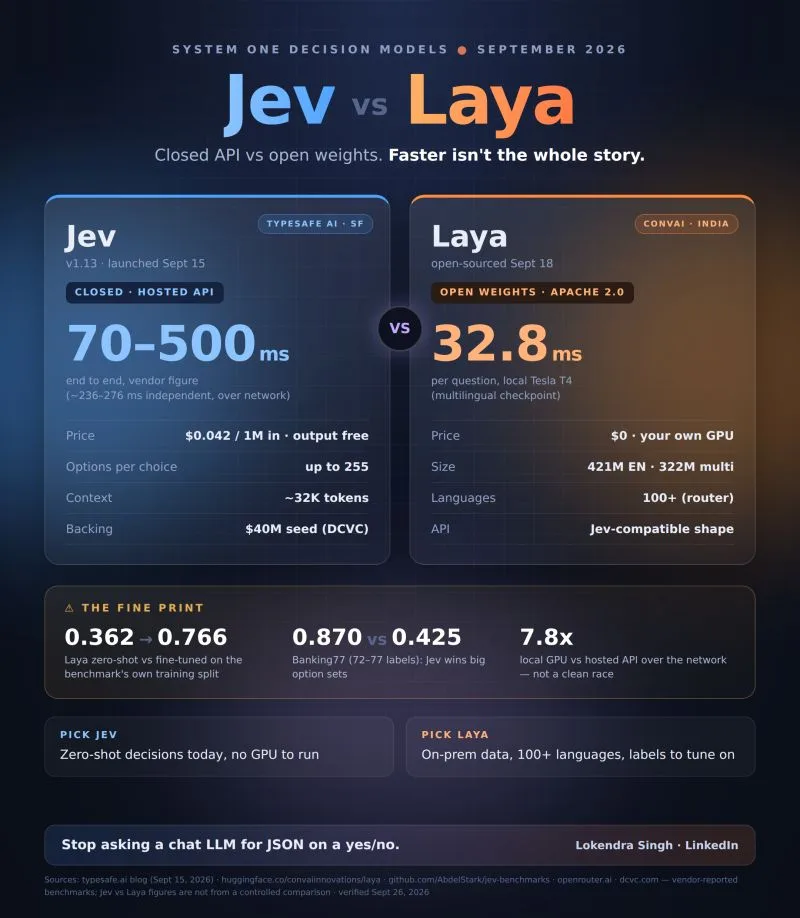
Jev launched on Sept 15 with a $40M seed. Three days later, an Indian founder open-sourced Laya and called it 7.8x faster. I read both model cards.
Both are "System One" models. No text output: you send state plus typed questions (pick, score, yes/no) and get calibrated probabilities in one pass.
Jev - TypeSafe AI, San Francisco
- Closed API, early access
- $0.042 per 1M input tokens, output free
- 70–500 ms end to end (TypeSafe's figure)
- Up to 255 options per choice
Laya - Convai Innovations, India
- Open weights, Apache 2.0
- 421M English + 322M multilingual, 100+ languages
- 32.8 ms per question on a Tesla T4
- Same request shape as Jev - swap the base URL
The honest part
- "7.8x" compares a local GPU pass with Jev's hosted API timed over the network (~236–276 ms). Not a clean race
- Laya's 0.766 accuracy is fine-tuned on the benchmark's own training split. Zero-shot: 0.362, below the 0.461 majority baseline
- Laya ships over-confident until you calibrate it on your own data
- Jev wins big label sets - Banking77 0.870 vs 0.425
- Jev's "193.6x faster" comes from TypeSafe's own workflows
My take
Jev is a product, Laya is a starting point. Zero-shot today, no GPU → Jev. Data stays on-prem, labels to fine-tune on → Laya. The real win is the pattern: stop asking a chat LLM for JSON on a yes/no.
Which decision in your stack is still an LLM call that shouldn't be? 👇
Sources
- TypeSafe - Introducing Jev (Sept 15, 2026)
- Laya model card
- Independent Jev pilot
- $40M seed: dcvc.com
// Originally posted on LinkedIn ↗