AEO, GEO, LLMO: what the evidence says
Everyone selling AEO, GEO or LLMO has a framework. Almost none of them have evidence. I checked. 👇
First, the reality check - in both directions:
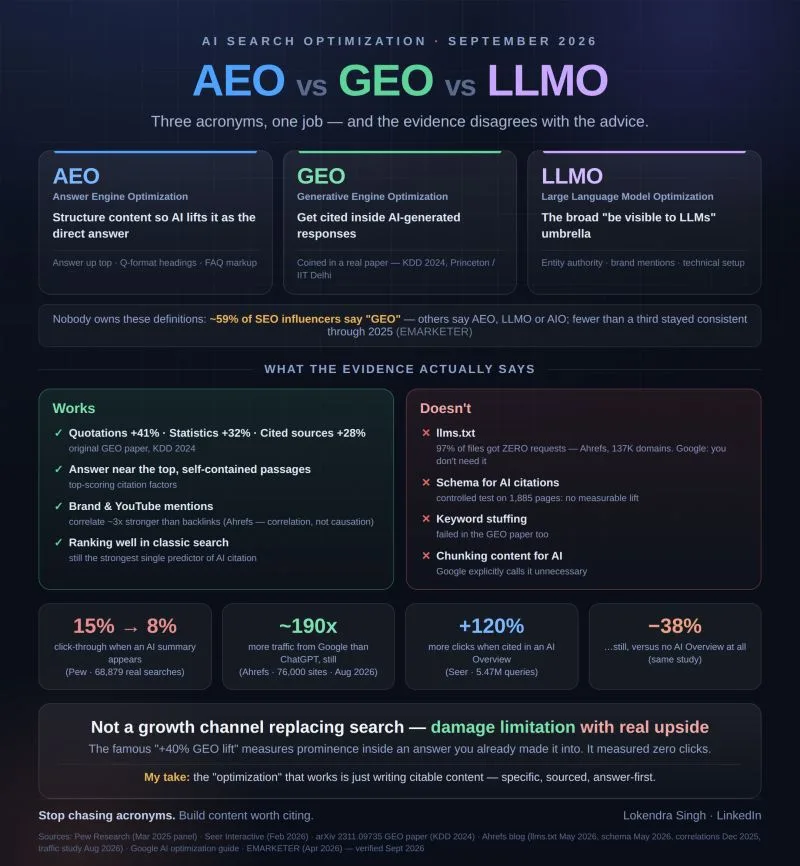
📉 When an AI summary appears, Google click-through drops 15% → 8%. Only 1% click a link inside it. (Pew, 68,879 real searches) 📉 68% of Google searches now end with zero clicks. (SparkToro/Similarweb, 2026) 📈 ...and yet Google still sends ~190x more traffic than ChatGPT. (Ahrefs, 76,000 sites, Aug 2026)
Both halves are true. Anyone quoting only one is selling.
The three acronyms, honestly
- AEO - "Answer Engine Optimization" be the direct answer
- GEO - "Generative Engine Optimization" get cited inside the AI response (the only one with a real paper behind it: KDD 2024)
- LLMO - "Large Language Model Optimization" the umbrella term. Nobody owns these definitions. Fewer than a third of SEO voices even used them consistently through 2025 (EMARKETER).
What the evidence supports
- Quotations +41%, statistics +32%, cited sources +28% (GEO paper)
- Answer near the top, in self-contained passages
- Brand mentions - correlate ~3x stronger with AI visibility than backlinks (Ahrefs; correlation, not causation)
- Ranking well in classic search - still the #1 predictor of being cited
What it doesn't
- llms.txt - 97% of files got ZERO requests across 137K domains. Google says you don't need it.
- Schema for citations - controlled test, 1,885 pages, no measurable lift
- Keyword stuffing, content "chunking" - dead, per the GEO paper and Google's own docs
⚠️ The caveat nobody quotes: that "+40% GEO lift" measures prominence within an answer your page already made it into. Zero clicks were measured. The reframe (Seer, 5.47M queries): being cited in an AI Overview earns +120% more clicks than not being cited - but still −38% vs no AI Overview at all.
My take
This isn't a growth channel replacing search. It's damage limitation with real upside - and the "optimization" that works is just writing citable content: specific, sourced, answer-first. Still chasing acronyms? 👇
Sources
- Pew Research (Jul 2025): pewresearch.org
- Seer Interactive (Feb 2026)
- GEO paper, KDD 2024
- Ahrefs - llms.txt, schema, correlation & traffic studies
- Google AI optimization guide
- Prompted by "AI SEO Full Course 2026" - Piyush Sachdeva
// Originally posted on LinkedIn ↗