One engineer, before lunch
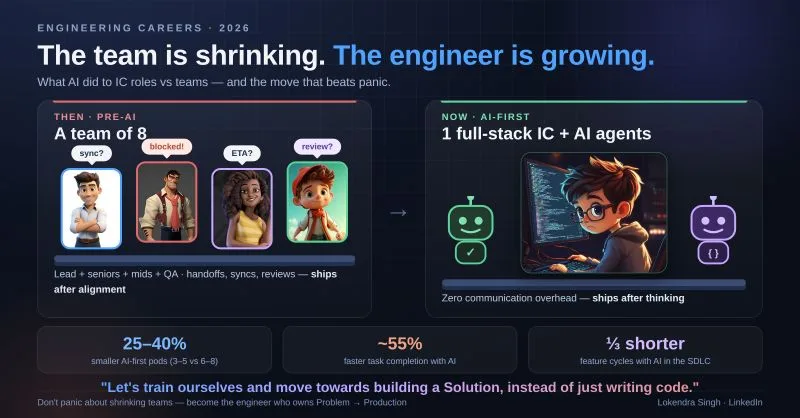
In 2019, this took a team of 8. In 2026, I watched one engineer do it before lunch. 👇
Let's be honest about what happened to engineering teams:
Then (pre-AI): 1 tech lead, 2–3 seniors, 2–3 mid-levels, 1 QA. Handoffs everywhere. Half the sprint spent in sync meetings, reviews, and waiting on each other.
Now (2026): AI-first pods run 25–40% smaller - 3–5 engineers covering the same product surface. And the sharpest ICs? They've quietly become one-person departments.
Why the IC is winning
- AI took the execution layer - scaffolding, tests, boilerplate, docs. What's left is judgment. One person with good judgment + AI agents has zero communication overhead.
- The data backs it - ~55% faster task completion with AI assistance, feature cycles down by a third when AI is embedded in the workflow.
- A team of 8 ships after alignment. An IC with agents ships after thinking. The part nobody says out loud: Yes, teams are shrinking. Panicking won't reverse it. Positioning will.
The engineers thriving right now aren't the best coders - they're the ones who stopped identifying as "backend" or "frontend" and started owning the whole problem: understand the user → design the system → build it with AI leverage → ship it → measure it. That's what full-stack means in 2026. Not React + Node. Problem → Production.
Let's train ourselves and move towards building a Solution, instead of just writing code.
Fair note: big systems still need teams - compliance, scale, 24/7 ops don't disappear. But the default unit of shipping has changed, probably forever. Are you still a role, or already a solution? 👇
Sources
- AI-first pods shrinking 25–40%
- Copilot productivity studies (~55% faster): GitHub research via same
- Solo workers becoming departments: forbes.com (May 2026)
- The 2026 engineer paradox: leaddev.com
// Originally posted on LinkedIn ↗